
For many international and domestic students entering postgraduate study in the UK, the transition from undergraduate to Master’s level (Level 7) feels less like a step and more like a leap. The most frequent feedback from tutors at Russell Group universities isn’t about grammar or formatting—it is the dreaded phrase: “Too descriptive; needs more critical analysis.”
In the UK academic tradition, “Critical Thinking” is the gold standard. It is the ability to not just report what an author said, but to interrogate why they said it, the limitations of their methodology, and how their work sits within the wider tapestry of the field. Mastering this is the key to moving from a “Pass” (50-59%) to a “Distinction” (70%+).
The Anatomy of a High-Scoring Graduate Essay
At the graduate level, a linear “point-evidence-explain” structure is rarely enough. UK markers look for a “synthesis” of ideas. This means your essay structure must be thematic rather than chronological.
Instead of dedicating one paragraph to Author A and the next to Author B, a high-scoring structure groups them by their arguments. You create a “conversation” on the page where different theories collide. However, even the most brilliant analysis can fail if the reader isn’t guided into the topic effectively.
The Power of the “Hook” in Postgraduate Discourse
In a sea of hundreds of submissions, the first paragraph is your only chance to signal your expertise to the marker. At the Master’s level, a “hook” isn’t just a catchy sentence; it is a “Problem Statement.” It identifies a gap in current research or a tension between two schools of thought.
Many students find that looking at specific essay hooks examples helps them understand the difference between a “broad” opening and a “scholarly” opening. For instance, instead of stating “Climate change is a big problem,” a graduate hook might state: “While current legislative frameworks focus on carbon mitigation, the socio-economic impact on Global South agrarian communities remains a critical, yet overlooked, variable.” This immediately signals to the examiner that you are thinking at a higher level.
Moving from Description to Evaluation
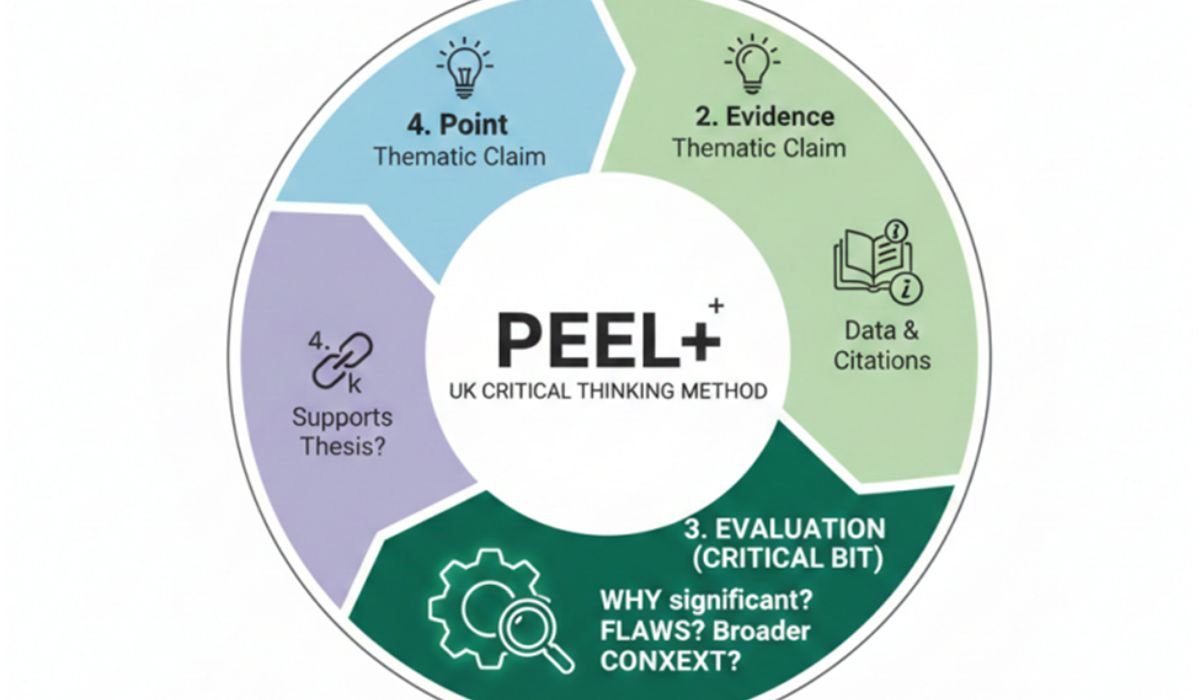
The “Critical Thinking Hurdle” usually occurs in the body paragraphs. To overcome this, UK students should follow the PEEL+ method:
- Point: A thematic claim.
- Evidence: Data or citations.
- Evaluation (The Critical Bit): Why is this evidence significant? Are there flaws in this data?
- Link: How does this support your overall thesis?
When you are juggling four modules, a part-time job, and the looming shadow of a 15,000-word dissertation, the cognitive load can quickly become overwhelming. It is at this stage of the semester that many students seek professional mentorship to bridge the gap between their research and a polished final draft. Often, reaching out to myassignmenthelp for expert college essay writing help can provide a vital structural blueprint or a “model answer” that demonstrates exactly how to balance these complex evaluative elements. Far from bypassing the hard work, this approach allows students to use a professional roadmap to better understand the specific academic rigour and critical depth required by UK examiners.
Navigating the “Silo” Trap
A common mistake in UK graduate essays is “Siloing”—treating every paragraph as an independent island. To rank well in the “Cohesion and Coherence” section of your marking rubric, you must use “signposting” language.
- Instead of “Also,” use “Furthermore, this perspective is bolstered by…”
- Instead of “But,” use “Conversely, a burgeoning body of literature suggests…”
These linguistic nuances show the marker that you are navigating the complexities of the subject matter with authority.
The Role of Feedback and Iteration
In the UK, the “first draft” is rarely the final submission. Graduate success is found in the editing phase. This is where you check if your “Voice” is clear. Ask yourself: If I removed all the citations, does my own argument still exist? If the answer is no, you haven’t been critical enough; you’ve simply been a librarian of other people’s ideas.
Conclusion
Mastering complex essay structures in the UK higher education system is a marathon, not a sprint. It requires a shift from being a “consumer” of knowledge to a “producer” of critique. By focusing on strong introductory hooks, thematic synthesis, and seeking the right academic support when the workload peaks, graduate students can navigate the ‘Critical Thinking’ hurdle and achieve the marks their hard work deserves.
About The Author
Ruby Walker is an education specialist and lead writer at Myassignmenthelp. Having worked closely with students across Russell Group universities, she understands the unique pressures of the UK semester system—from the initial dissertation proposal to the final submission.