
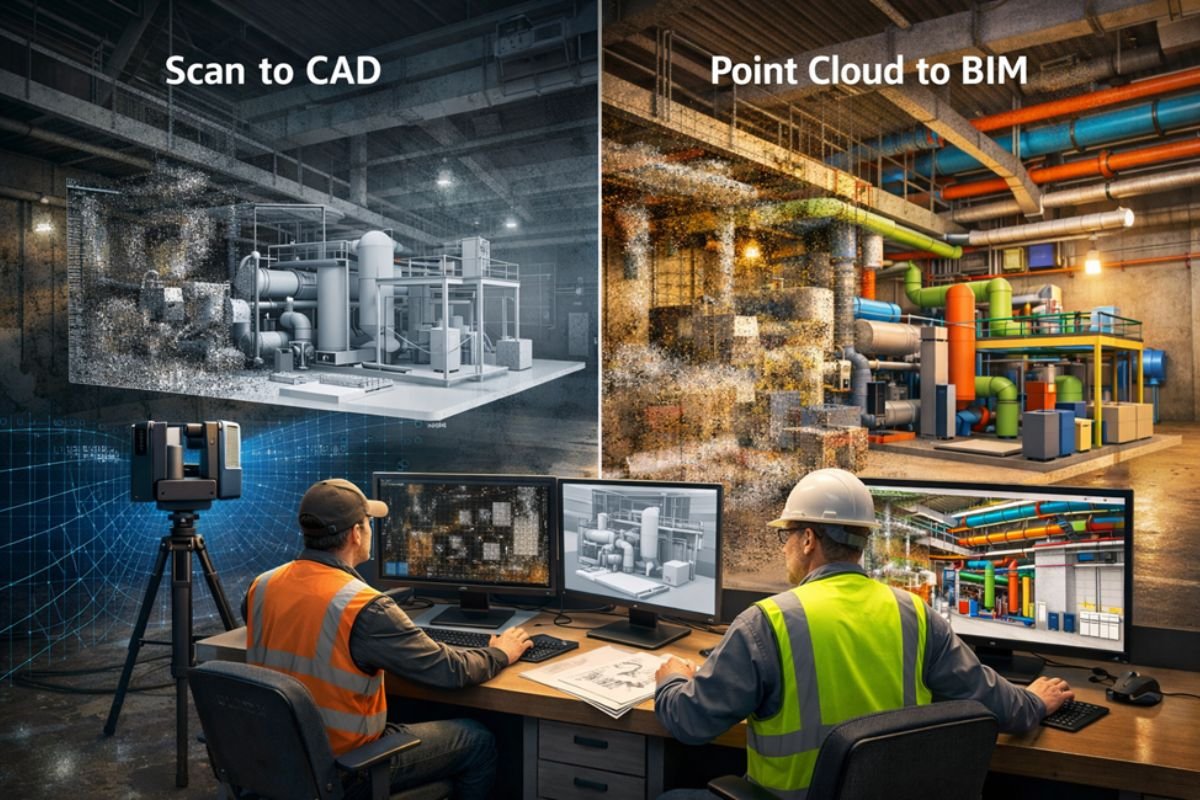
Digital transformation is rapidly reshaping the architecture, engineering, and construction (AEC) industry. From infrastructure modernization in the UK to large-scale development projects in the USA, companies are relying on advanced technologies to capture and convert real-world data into accurate digital models.
Two of the most widely used methods in this transformation are Scan to CAD and Point Cloud to BIM. Both processes help convert laser scan data into usable design formats, but they serve different purposes depending on the complexity, project goals, and level of detail required.
For business owners, architects, engineers, and construction professionals, choosing between these two workflows can be challenging. Understanding the differences is crucial when investing in scan to cad conversion services or selecting the right digital modeling solution.
This article explores the key differences, benefits, challenges, and industry trends related to Scan to CAD and Point Cloud to BIM to help you determine which solution is better for your project.
What Is Scan to CAD?
Scan to CAD is the process of converting 3D laser scan data or point cloud data into 2D drawings or simplified 3D CAD models. These files are typically delivered in formats such as DWG, DXF, or other CAD-compatible formats used by architects and engineers.
The goal of scan to cad conversion services is to create accurate digital drawings from real-world measurements.
Common outputs include:
- 2D floor plans
- Elevations and sections
- As-built drawings
- Mechanical layouts
- Structural CAD drawings
These outputs are particularly useful when working on renovation, refurbishment, or documentation projects where a full BIM model is unnecessary.
Businesses often rely on customized cad conversion services when they need drawings tailored to their specific software standards, layer structures, and documentation requirements.
What Is Point Cloud to BIM?
Point Cloud to BIM takes the process further by converting scan data into intelligent Building Information Models (BIM).
Unlike CAD drawings, BIM models include detailed information about every element in the structure. Each component walls, doors, windows, HVAC systems contains data that can be used for planning, maintenance, and facility management.
This workflow is widely used in complex projects such as:
- Infrastructure modernization
- Large commercial buildings
- Hospitals and airports
- Industrial plants
- Smart city developments
Point cloud conversion services create highly detailed models in BIM platforms such as Revit, enabling teams to collaborate across multiple disciplines.
Why Are Laser Scanning and CAD Conversion Growing So Fast?
The demand for digital building documentation is increasing worldwide.
According to a report on the Global Building Information Modeling Market Report, the BIM market is projected to surpass $15 billion globally by 2027, driven by increased adoption across architecture and construction sectors.
Similarly, the use of laser scanning technologies is expanding rapidly. Data from the National Institute of Building Sciences highlights that digital modeling and scanning technologies can reduce project costs by up to 20% through improved planning and error reduction.
These trends explain why many companies in the UK and USA are investing heavily in cad conversion services in USA and advanced digital modeling solutions.
How Does Scan to CAD Work?
The scan-to-CAD process typically involves the following steps:
- Laser Scanning
High-precision scanners capture millions of data points from the physical environment. - Point Cloud Generation
The captured data is processed into a 3D point cloud representing the geometry of the structure. - Data Processing
Noise removal, alignment, and data optimization are performed. - CAD Drafting
Technicians convert the point cloud into 2D or simplified 3D CAD drawings. - Quality Verification
The drawings are checked against the scan data to ensure accuracy.
This workflow makes scan to cad conversion services ideal for projects that require precise measurements but not full BIM models.
When Should You Use Scan to CAD Instead of BIM?
Scan to CAD is usually the better choice when:
- The project requires 2D documentation
- Budget constraints exist
- The building is relatively simple
- The client only needs as-built drawings
Typical use cases include:
- Residential renovations
- Office layout redesign
- Real estate documentation
- Historic building surveys
In such cases, customized cad conversion services provide cost-effective solutions without the complexity of BIM.
When Is Point Cloud to BIM the Better Option?
Point Cloud to BIM becomes essential when projects require detailed digital twins or lifecycle management.
You should choose BIM when:
- The project involves large infrastructure
- Multiple engineering disciplines must collaborate
- Long-term facility management is required
- High levels of accuracy and metadata are needed
Major infrastructure developments in the UK and USA increasingly depend on BIM workflows to manage complex construction environments.
For example, the HS2 High Speed Rail Project in the United Kingdom uses advanced digital modeling technologies to manage one of the largest infrastructure projects in Europe.
What Are the Main Differences Between Scan to CAD and Point Cloud to BIM?
Understanding the core differences helps businesses choose the right technology.
Scan to CAD
- Produces 2D drawings or simple 3D models
- Faster and more cost-effective
- Ideal for smaller projects
- Limited data intelligence
Point Cloud to BIM
- Produces intelligent 3D BIM models
- More detailed and data-rich
- Suitable for complex projects
- Higher cost and processing time
Both workflows rely heavily on point cloud conversion services, but the final output and level of detail differ significantly.
What Challenges Do Businesses Face When Choosing Between the Two?
Despite their benefits, organizations often encounter several challenges when implementing digital modeling technologies.
1. Data Complexity
Laser scans generate extremely large datasets that require specialized software and skilled professionals to process.
2. Skilled Workforce Shortage
There is a growing demand for professionals trained in BIM and CAD conversion workflows.
The Royal Institution of Chartered Surveyors has highlighted the increasing skills gap in digital construction technologies across global markets.
3. Software Compatibility
Companies must ensure compatibility between scanning technologies, CAD platforms, and BIM software.
4. Cost Considerations
While BIM offers greater capabilities, the cost of modeling and processing is significantly higher compared to traditional scan to cad conversion services.
How Are AI and Automation Transforming CAD Conversion?
Artificial intelligence and machine learning are beginning to play a major role in digital modeling workflows.
New AI-driven software tools can automatically detect building elements such as walls, floors, and windows within point cloud data. This automation significantly reduces the time required for point cloud conversion services.
Industry analysts predict that AI-assisted modeling could reduce manual drafting time by up to 40% in the coming years, making digital documentation faster and more affordable.
This trend is particularly important for companies offering cad conversion services in USA and other global markets where demand for rapid project delivery continues to grow.
Which Solution Is Better for Your Business?
The answer ultimately depends on the scope, complexity, and long-term goals of your project.
Choose Scan to CAD if:
- You need quick and accurate 2D drawings
- Your project involves simple building documentation
- Budget efficiency is a priority
Choose Point Cloud to BIM if:
- Your project requires detailed digital models
- You need cross-disciplinary collaboration
- Long-term facility management is important
Many organizations today use both technologies together. They start with scan-to-CAD drawings and later upgrade to BIM models when the project requires deeper data integration.
The Future of Digital Modeling in Architecture and Construction
As digital transformation accelerates across the construction industry, technologies like laser scanning, BIM, and AI-driven modeling will continue to reshape how buildings are designed and managed.
Companies that adopt scan to cad conversion services and advanced point cloud conversion services early will gain significant competitive advantages.
From urban infrastructure projects in London to commercial developments across the United States, digital modeling is becoming a critical component of modern architecture and engineering workflows.
Conclusion
Scan to CAD and Point Cloud to BIM are both powerful technologies that help transform real-world structures into digital models. While scan to cad conversion services provide fast and cost-effective documentation, point cloud conversion services enable deeper analysis, collaboration, and lifecycle management.
For startups, architects, engineers, and construction businesses, choosing the right solution depends on the project requirements, available resources, and long-term goals.
As demand for digital construction technologies continues to grow globally, partnering with experienced CAD specialists can make a significant difference. Leading UK CAD design firms are now helping businesses leverage customized cad conversion services to streamline workflows, improve accuracy, and support the next generation of smart building projects.
FAQs
1. What is Scan to CAD conversion?
Scan to CAD conversion is the process of transforming laser-scanned point cloud data into accurate 2D drawings or simplified 3D CAD models. Businesses use scan to cad conversion services to create as-built floor plans, elevations, and engineering drawings from real-world measurements.
This method is widely used in renovation, facility management, and architectural documentation projects.
2. What is the difference between Scan to CAD and Point Cloud to BIM?
The main difference lies in the level of detail and intelligence in the final output.
- Scan to CAD produces 2D drawings or basic 3D CAD models.
- Point Cloud to BIM creates intelligent 3D building models that include structural and architectural data.
Point Cloud to BIM is typically used for complex construction projects, while scan to cad conversion services are more suitable for simpler documentation tasks.
3. When should businesses use Scan to CAD conversion services?
Businesses should use scan to cad conversion services when they need fast and accurate documentation of existing buildings.
Common use cases include:
- Renovation planning
- As-built documentation
- Facility management drawings
- Interior redesign projects
This approach is more cost-effective than BIM modeling for smaller projects.
4. What industries use point cloud conversion services?
Several industries rely on point cloud conversion services, including:
- Architecture and construction
- Engineering and infrastructure
- Manufacturing plants
- Oil and gas facilities
- Real estate development
These services help convert laser scanning data into usable digital models for analysis and planning.
5. Are CAD conversion services still relevant in the BIM era?
Yes, CAD conversion services in USA and globally remain highly relevant because many projects still require 2D documentation rather than full BIM models.
CAD drawings are faster to produce, easier to share, and compatible with a wide range of design software used by architects and engineers.
6. How accurate are scan to CAD conversion services?
Modern scan to cad conversion services are extremely accurate because they rely on laser scanning technology that captures millions of data points from a structure.
Depending on the equipment used, the accuracy level can reach 2–5 millimeters, making it suitable for architectural and engineering documentation.
7. Is Point Cloud to BIM more expensive than Scan to CAD?
Yes, Point Cloud to BIM is generally more expensive because it involves creating detailed 3D models with embedded building information.
However, BIM models provide long-term benefits such as:
- Improved project coordination
- Better construction planning
- Enhanced facility management
Many companies start with customized cad conversion services and later upgrade to BIM when the project requires deeper data integration.
8. Which is better: Scan to CAD or Point Cloud to BIM?
Scan to CAD is better for projects that require fast, cost-effective 2D drawings, while Point Cloud to BIM is ideal for complex construction projects requiring detailed 3D models and building data. The best option depends on project size, budget, and long-term requirements.
 Admin
Admin